

The 2021 Cangzhou Feed Industry Association Annual Meeting was successfully held at the Guozhuang Branch of Leshou Duck Industry.
Release date:
2021-06-12
Follow · Click the blue text to follow me! To fully leverage the association's role as a bridge and link, and to actively promote the sustainable development of Cangzhou's feed industry, the Cangzhou Feed Industry Association held its chairman meeting on June 12 at the Guozhuang Branch of Leshou Duck Industry. Over 20 representatives attended, including the president and vice presidents of the association, as well as heads of leading feed companies. Wang Jiusheng, Deputy Director of the Municipal Agriculture and Rural Affairs Bureau, and Li Yue, Chief of the Animal Husbandry Division of the same bureau, also joined the meeting and delivered important speeches. Key attendees included: - Gao Xijun, Chairman of Leshou Group and President of the Cangzhou Feed Industry Association; - Wei Zehai, Secretary-General of the Cangzhou Feed Industry Association; - Wang Yanbo, Deputy Secretary-General of the Cangzhou Feed Industry Association.
Follow ·
Click the blue text to follow me!


To fully leverage the association's role as a bridge and link, and to actively promote the sustainable development of Cangzhou's feed industry, the Cangzhou Feed Industry Association held its chairman meeting on June 12 at the Guozhuang Branch of Leshou Duck Industry. More than 20 participants attended, including the president and vice presidents of the association, as well as heads of leading feed companies. Wang Jiusheng, Deputy Director of the Municipal Agriculture and Rural Affairs Bureau, and Li Yue, Chief of the Animal Husbandry Division of the same bureau, also joined the meeting and delivered important speeches.

Gao Xijun, President of Leshou Group and Chairman of the Municipal Feed Industry Association

Wei Zehai, Secretary-General of the Municipal Feed Industry Association

Wang Yanbo, Deputy Secretary-General of the Municipal Feed Industry Association
The meeting was chaired by Secretary-General Wei Zehai. President Gao Xijun delivered a report summarizing the association's achievements in 2020 and outlining the work plan for 2021. He also highlighted how, in 2020, the association worked together to combat the pandemic, ensuring stable supply and production while providing essential services. Following his remarks, attendees took turns sharing their insights, engaging in lively discussions and offering valuable suggestions on how to strengthen the association's operations and maximize its impact. Finally, the meeting expressed heartfelt gratitude to the Municipal Bureau of Agriculture and Rural Affairs for their strong support of feed enterprises.

Director of the Animal Husbandry Division, Municipal Agriculture Bureau · Li Yue
Li Yue, Head of the Animal Husbandry Division at the Municipal Agriculture Bureau, emphasized in her speech that participating companies must strengthen industry self-discipline, enhance the quality and safety standards of feed production, and ensure compliance with regulatory production practices. Finally, Deputy Director Wang Jiusheng delivered a keynote address, highlighting this year’s key priorities: "Safety, Improvement, and Integration." He explained that "Safety" encompasses not only safe production and quality assurance but also environmental protection measures. All member organizations have identified safe production as their top priority, and the Bureau will soon launch comprehensive safety inspections to guarantee no incidents occur ahead of the 100th anniversary of the Communist Party of China. Li also stressed the critical need to prioritize quality and safety, noting that current challenges include inconsistent labeling and standards, as well as instances of unauthorized addition of pharmaceutical additives—issues that must be firmly addressed. Additionally, he underscored the importance of environmental safety, particularly in relation to upstream livestock farmers. From a service-oriented perspective, he urged everyone to properly manage manure by returning it to the fields for agricultural use, while actively providing robust community support. Together, these efforts will ensure smooth progress in environmental protection initiatives.
In terms of "enhancement," the provincial government has introduced four key agricultural initiatives, launching the new "Three Excellence and One Standard" strategy—focused on variety improvement, quality enhancement, brand development, and standardized production. All units involved in production should adopt a systematic approach, prioritizing quality improvements to ensure reliable supply. Additionally, efforts should be intensified to build strong brands by distilling core elements of corporate culture and identifying the right market-entry points for effective promotional strategies, ultimately driving greater market success.
"Regarding 'integration,' we will strengthen the integrated development of primary, secondary, and tertiary industries, seamlessly linking the first, second, and third sectors of the industrial chain. We’ll carefully craft a comprehensive development plan, adopt a forward-thinking approach, and pursue high-quality growth by clearly defining our strategic direction. The city has already identified animal husbandry as a key industry and pinpointed specific industrial clusters to receive prioritized support. As a result, financial resources from various sources are being concentrated on these targeted clusters, with a strong focus on fostering the high-quality development of city-level, distinctive industrial ecosystems."

Deputy Director of the Municipal Agriculture Bureau, Wang Jiusheng
Director Wang concluded by emphasizing that the association has effectively carried out its duties, providing comprehensive services to its member organizations. Moving forward, the association will organize more events, invite industry and safety experts to conduct training sessions for businesses, and actively promote relevant laws and regulations. Safety in production will be firmly prioritized, with intensified efforts in both awareness-raising and skill development. Additionally, the association aims to broaden its perspectives, fostering greater opportunities for exchange and learning—encouraging members to collaborate with larger enterprises, thereby creating chances for knowledge sharing and growth. This approach will help continuously enhance management practices, strengthen individual capabilities, and ultimately contribute to the healthy development of Cangzhou’s feed industry.
After the meeting, attendees posed for a commemorative group photo.

Hebei Leshou Duck Industry Co., Ltd. is a wholly-owned subsidiary invested in by Leshou Agricultural and Pastoral Group Co., Ltd. The company was established in 2007. Headquartered in the Xian County Economic Development Zone, Cangzhou City, Hebei Province, Leshou Duck Industry operates 14 production facilities spanning a total area of 1,225 mu. Today, the company employs a total of 1,409 people. Renowned nationwide as a leading producer of roasted duck carcasses, Leshou Duck Industry’s core business encompasses breeding parent ducks, feed processing, meat duck farming, slaughter and carcass preparation, meat cutting and portioning, cooked food processing, as well as a nationwide chain of roasted duck and ready-to-eat food stores. Together, these operations have created a well-integrated industry chain that seamlessly combines primary, secondary, and tertiary sectors, enabling the company to achieve fully integrated business management.
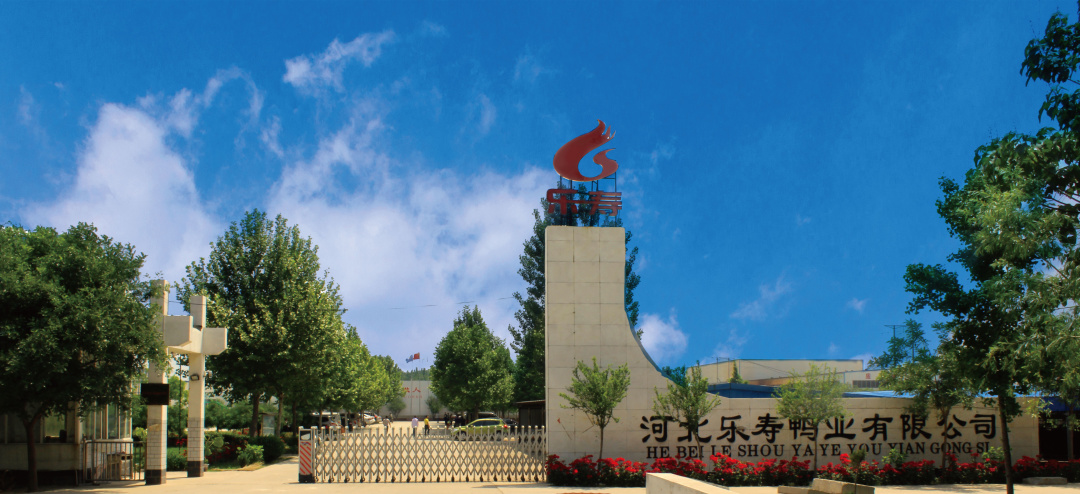
The company is a nationally recognized, state-level leading enterprise in agricultural industrialization and a well-known producer of pre-roasted duck carcasses nationwide. Its core product lines include roasted duck blanks, portioned duck meat, various livestock and poultry feeds, leisure-style braised duck products, and a chain of roasted duck restaurants. The company operates three breeding duck farms, three feed mills, two slaughterhouses, one cooked-food factory, and over 210 retail outlets—ranging from duck restaurants to specialty food stores. The "Le Shou" brand roasted duck blanks are bestsellers across China, accounting for approximately 10% of the country’s total production of Beijing-style roast duck, making it a flagship product in the duck blank industry. The company ranks among the top players in terms of overall strength within the duck blank sector.
The company leverages its affiliated enterprises within the group to significantly expand the entire Peking duck industry chain, successfully achieving an integrated "primary, secondary, and tertiary industries" model. Currently, the company operates three duck carcass production lines— including one dedicated to halal-certified duck products—with a combined daily slaughtering and processing capacity of 55,000 ducks. Annually, the company produces 17 million duck carcasses. Notably, the Leshou Halal Workshop boasts the largest halal-certified Peking duck carcass production line in China today, enabling the company to fully meet the diverse product demands of its customers.
"The Leshou Duck Industry Guozhuang Slaughtering Facility in Xian County broke ground in March 2019 and was completed—and officially put into operation—in March 2021. The project boasts a total investment of 150 million yuan, with a total construction area of 31,209 square meters. It features two production lines: one dedicated to duck segmentation and another for producing duck carcasses, collectively capable of processing up to 45 million meat ducks annually."
Tags:
Recommended News

Unit Name:
Le Shou Agricultural and Pastoral Group Co., Ltd. – Hebei Branch
Service hotline:
0317-4600668
Contact address:
Xian County, Cangzhou City, Hebei Province

Official Account